|
| Academic Experience - Forensic
Books |
 |
Roger W. Shuy
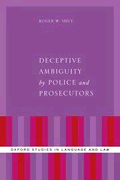
Deceptive Ambiguity by Police and Prosecutors, 2017, Oxford University Press
Officials of law enforcement often complain that their suspects and defendants are deceptive. This book does not disagree but instead tries to even the playing field by demonstrating how police use deceptive ambiguity during their interviews with suspects and how prosecutors use it as they question defendants in courtroom settings.
The book describes fifteen criminal investigations that demonstrate how police, prosecutors, and undercover agents used deceptive ambiguity with their subjects and targets resulting in misrepresentations to their subjects in the ways government officials misrepresented and handled speech events, schemas, agendas, speech acts, lexicon, and grammar.
In undercover operations the government approves some types of intentional deception, but their deceptive uses of ambiguity are not often recognized. Although police officers and prosecutors are not permitted to use trickery or coercion to deceive those with whom they interact, their uses of deceptive ambiguity demonstrated in this book have gone largely unnoticed.
|
 |
Roger W. Shuy
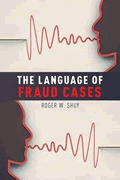
The Language of Fraud Cases, 2016, Oxford University Press
In The Language of Fraud Cases, Roger Shuy follows the now well-established format of his previous volumes on language and law. He discusses here eight cases that he himself has consulted on, and that illustrate how linguistics can help to solve the various problems that arise in trying to define fraudulent language in the context of law. He examines speech events, schemas, agendas, speech acts, conversational strategies, as well as smaller language units such as sentences, phrases, words, and sounds, and discusses how these can play a major role in deciding fraud cases. The cases chosen for this volume hinge on recorded language evidence, making them particularly relevant for linguistic analysis, and include cases of government contracts, EPA regulations, foreign corrupt business practices, trade secrets, money laundering, securities trading, art theft, and price fixing. Through his examination of these cases, Shuy demonstrates the significant contribution of linguistic analytical methodology to the understanding of language evidence and its success in revealing willful uses of fraudulent language to achieve financial gain.
|
 |
Roger W. Shuy
Speaking of Language and Law. (co-edited with L. Solan and J. Ainsworth), 2015, Oxford University Press
In the quarter century that he wrote about issues concerning language and law, Peter Tiermsa (1952 - 2014) made his mark in one important area of inquiry after another. Trained in both law and linguistics, Tiersma was uniquely perceptive in extracting the ways in which the use of language influences legal practice and theory. His work has been enormously influential in areas ranging from the formation of contracts to the language of criminal justice to the law of defamation.
This book doubles as a tribute to Tiersma’s great work and as a collection of short, poignant essays by leading scholars from around the world on important questions of language and law. Reprinted are 17 short excerpts from Tiersma’s writings accompanied by 32 commentaries produced for this volume. These commentaries use Tiersma’s work as a springboard to engage with the significant issues that Tiersma himself raised during his career.
Because Tiersma’s work was itself so broad, the contributors to this book range in their expertise and include scholars in law, linguistics, criminology, philosophy, anthropology, psychology, history and medicine. The book is organized around the major areas that make up Tiersma’s body of writing: legal language and its history, the language of contracts and wills, the meaning of silence in law, consenting, defaming, interpreting laws, language and criminal justice, and the language of jury instructions. The volume not only makes available a broad selection of works by a great scholar, but uses those works as a means of drawing out new ideas and perspective that have germinated from Tiersma’s work.
|
 |
Roger W. Shuy
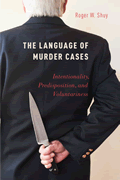
The Language of Murder Cases, 2014, Oxford University Press
The Language of Murder Cases describes fifteen court cases for which Roger W. Shuy served as an expert language witness. Investigations and trials in murder cases are guided by the important legal terms describing the mental states of defendants: intentionality, predisposition, and voluntariness. Unfortunately, statutes and dictionaries can provide only loose definitions, largely because mental states are virtually impossible to define. The meaning of these terms, therefore, must be adduced either by inferences and assumptions, or by any available language evidence—often the best window into a speaker’s mind. Fortunately, this window of evidence exists primarily in electronically recorded undercover conversations, police interviews, and legal hearings and trials, all of which are subject to linguistic analysis before and during trial.
In this book, Shuy explains how vague legal terminology can be clarified by analysis of the language used by suspects, defendants, law enforcement officers, and attorneys. He examines speech events, schemas, agendas, speech acts, conversational strategies, as well as smaller language units such as syntax, lexicon, and phonology, and discusses how these can play a major role in deciding murder cases. In his analysis, Shuy draws on his personal experience testifying at fifteen fascinating murder cases, focusing on the role that language played in each. He concludes with a summary of how his analyses were regarded by the juries as they struggled with the equally vague concept of reasonable doubt.
|

Buy This Book >> |
Roger W. Shuy
The Language of Bribery Cases, 2013, Oxford University Press
In The Language of Bribery Cases, Roger W. Shuy analyzes the role that language plays in twelve bribery cases for which he served as an expert witness or consultant. He explains the issues at stake in each case for the benefit of both lawyers and linguists. The cases include charges of bribery or alleged bribery of United States senators, congressmen, judges, businessmen, and brother commissioners, pointing out that the analytical tools he used are available to both the defense and the prosecution as they argue their case, although it is rare that prosecutors call for help from linguists. These analytical procedures include grammatical referencing, speech acts, discourse structure, framing, the use of conveyed meaning, and clues to intentionality.
|

Buy This Book >> |
Roger W. Shuy
The Language of Sexual Misconduct Cases, 2012, Oxford University Press
The Language of Sexual Misconduct Cases analyzes the many ways in which language plays a crucial role in sexual misconduct cases. Roger W. Shuy describes eleven court cases for which he served as an expert witness, and explains the issues at stake in each case for both lawyers and linguists. The book's attention is on aspects of sexual misconduct that have not previously received the attention they deserve, such as: the language evidence of sexual misconduct in the workplace; cases of adult-to-child sexual misconduct with the family; and adult-adult sexual misconduct cases. Shuy describes the often-used linguistic analytical tools that are available to both the prosecution and the defense, and argues that there is a particular
sequence in which these tools should be used.
|

Buy This Book >> |
Roger W. Shuy
The Language of Perjury Cases, 2011: Oxford University Press
This book describes perjury law and how the evidence in perjury cases was linguistically analyzed. Eleven representative perjury cases are described, including issues of false statements in bankruptcy, squabbles between unions and management, quarrelling physicians, complex hunting license forms, and the testimony of shipping executives, attorneys, priests and a U.S. senator. The linguistic tools applied in these cases include identifying the speech events, schemas, agendas, speech acts, conversational strategies, cooperative principle, and the ways language ambiguity can be resolved.
|

Buy This Book >> |
Roger W. Shuy
The Language of Defamation Cases, 2010: Oxford University Press
Since slander and libel cases are largely about how one party uses language in ways that are claimed to defame another, linguistic expertise can be central to resolving these cases. The Language of Defamation Cases describes eleven representative lawsuits-involving newspapers, television stations, religious leaders, physicisns, teachers, entertainers, unions, insurance companies, and manufacturers-in which linguistic analysis played an important role. Grammatical referencing, speech acts, descourse structure, framing, conveyed meaning, clues to intentions, and malicious language affected the outcomes of these cases.
|

Buy This Book >> |
Roger W. Shuy
Fighting Over Words, 2007: Oxford University Press
Words and language are the cause of much human conflict and are often the battleground on which such conflicts are fought. This is especially true of the civil law, where the usage and meaning of words form the crux of debates that are commonly resolved by precise analysis and interpretation. Civil cases are thus fertile ground on which to look at the role of language and the law.
By looking at specific cases in the civil law, the author shows how the skills of linguistic analysis can be used to resolve disputed meanings and how civil cases are important for linguistic scholarship. The illustrative cases include analyses involving contracts, advertisements, product liability, copyright infringement, discrimination, trademark disputes, and fraud controversies. In each case the author employs the tools of formal linguistics to show how linguistics can be as helpful as the physical sciences in resolving legal disagreements.
|

Buy This Book >> |
Roger W. Shuy
Linguistics in the Courtroom: A Practical Guide, 2006: Oxford University Press
More and more frequently, linguists are being called to consult with lawyers and to testify at trials. The field known as “forensic linguistics” is growing rapidly as linguists analyze spoken and written language evidence in both civil and criminal cases. This book is a practical, how-to guide for both beginning and established linguists who have been called upon in this capacity and who may want to start their own consulting practice. Step by step, the book deals with issues of how linguists first become and then represent themselves as experts, how they can start and manage the practice of consulting on law cases, how they can address important issues of professional ethics, how they can work most effectively with lawyers, useful strategies for writing reports and affidavits, and how to participate successfully in depositions, direct examinations and cross examinations at trial. It also suggests ways that linguists can use their forensic linguistic experiences in their publications and classroom teaching, concluding with suggestions of some recent books that forensic linguists may need for their personal libraries. Both American and British legal systems are covered. |

Buy This Book >> |
Roger W. Shuy
Creating Language Crimes: How Law Enforcement Uses (and Misuses) Language, 2005: Oxford University Press
This book by Roger W. Shuy, the senior figure in forensic linguistics, is the first to explain in an accessible way the vital role that linguistic evidence and its proper analysis play in criminal investigations. Shuy provides compelling case studies of how language functions in investigations involving, among others, wired undercover operatives, and the interrogation of suspects. He makes the point that language evidence can be as important as physical evidence, but yet does not enjoy the same degree of scrutiny by investigators, attorneys, and the courts. Beyond this, however, his more controversial thesis is that police frequently misuse or manipulate language, using various powerful controversial strategies, in order to intentionally create an impression of the targets' guilt or even to get them to confess. |
Buy This Book >> |
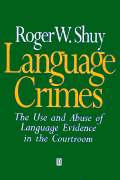
Roger W. Shuy
Language Crimes: The Use and Abuse of Language Evidence in the
Courtroom, 1993, Oxford: Blackwell (reprinted in 1996)
Solicitation to murder, bribery, threatening, extortion, perjury--all
thse are criminal acts whose medium is language. Since the 1970s
American law enforcement agencies have been covertly tape recording
conversations to bring such crimes to justice. With increasing
frequency the decision of the court has come to turn on this
taped evidence--and unravelling the ambiguity and misunderstanding
that such evidence brings. Language Crimes tells the story of
some of the remarkable cases that Roger Shuy, as a linguist,
has served as an expert witness. They include:
• the trial of automobile executive John Z. DeLorean
• the US Senate hearing concerning disciplinary action
to be taken against Senator Harrison A. Williams in the wake
of the FBI's Abscam operation and the cases of lesser known,
average Americans, including a San Jose jeweller, a Honolulu
union representative, a Kansas City lawyer, and two Nevada brothel
commissioners. |

Buy This Book >> |
Roger W. Shuy
The Language of Confession, Interrogation, and Deception, 1998,
Thousand Oaks CA: Sage Publications.
Taking a linguistic point of view, this book is a practical
explanation of how confessions work. It examines criminal confessions,
the interrogations that elicit them, and the deceptive language
that plays a role in the confession event. It presents transcripts
from numerous interrogations and analyzes how language is used,
how constitutional rights are protected (or not), consistency
and truthfulness, suggestibility, written confessions, as well
as unvalidated confessions. It concludes with specific advice
on how to conduct interrogations that will yield credible evidence. |

Buy This Book >> |
Roger W. Shuy
Bureaucratic Language in Government and Business, 1998, Washington
DC: Georgetown University Press.
Plunging into the verbal quagmire of official language used
by bureaucrats in both government and business, this book develops
new techniques based on linguistic principles to improve their
communication with the public. Nine case studies reveal representative problems with
bureaucratic language and describes how linguists can provide
bureaucrats with both the tools for communicating more clearly
and also the authority to implement these changes. The book
draws on documents cited in class action lawsuits brought against
the Social Security Administration and Medicare and offers a
detailed linguistic analysis of these agencies' problems with
written and oral communication. It also outlines a training
program the author developed for government writers to solve
them. Moving to the private sector, examples are given of the
ways that businesses such as car dealerships, real estate and
insurance companies, and commercial manufacturers sometimes
fail to communicate effectively. Although typically bureaucracies
change their use of language only when a lawsuit threatens,
the book argues that clarity in communication is a cost effective
strategy for preventing or at least reducing litigation. In
short, the book explains why bureaucratic language can be so
hard to understand and what can be done about it. |

Buy This Book >> |
Roger W. Shuy
Linguistic Battles in Trademark Disputes, 2002, New York: Palgrave
Macmillan.
Linguistics is based on the truth about how language works and
trademark disputes, largely about language, are governed by
the authority of law. But what happens when truths about language
and society are come to grips with the authority of law? Can
a corporation own words? Can a corporation gain exclusive righes
to a morpheme like the patronymic prefix, Mc-, in McDonalds?
This book is addressed to three audiences: trademark lawyers
who may not be familiar with how linguistic analysis can assist
them with their cases, linguists who may not be familiar with
how to work with trademark lawyers, and social scientists interested
in institutional authority, power and control and who have concerns
about how the legal community enforces its own language policy
and planning in the context of trademark law. The contributions
of linguists in ten actual trademark cases are presented, each
with a focus on a somewhat different trademark issue. In five
of these cases, linguistic experts were used by both sides. |

Buy This Book >> |
Jana Staton,
Roger W. Shuy and Ira Byock
A Few Months to Live: Different Paths to Life's End, 2001, Washington
DC: Georgetown University Press.
This book is an ethnographic study that describes what dying
is like from the perspectives of nine terminally ill patients
and their caregivers. It documents these end-of-life experiences
from detailed conversations in home care settings. It focuses
on how patients lived their daily lives, understood their illnesses,
coped with symptoms--especially pain--and searched for meaning
or spiritual growth in their final months of life. The accounts
are presented largely in the participants' own words, illuminating
both the medical and non-medical challenges that arose from
the time each learned the "bad news" through their
final days of life and memorial services. Describing the nationwide
crisis that surrounds end-of-life care, the authors contend
that informal caregiving by relatives and close friends is an
enormous and too-often invisible resource that deserves close
and public attention. By incorporating not only the ill person's
but also the family's perspective, the nine participants are
portrayed in the context of their daily lives and relationships
rather than simply as medical patients. Other issues addressed
are palliative care, quality of life, financial hardship, grief
and loss, and communications with medical personnel. The book
concludes with recommendations about the way families, professionals,
and communities can respond to the challenges of terminal illness
and the need to confront life's end. |
|
|